






 long-gone sights
street traders early 20th century
policemen early-mid 20th century
fogs
long-gone sights
street traders early 20th century
policemen early-mid 20th century
fogsand smogs gasometers and
gasworks tanks and planes in WW2 police
in WW2 fur coats lift boys & petrol attendants men
doffing
hats knickers
falling
down newsvendors


Gasometers, gasworks, coal gas and coke
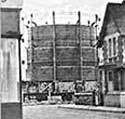
In Victorian times right up until the middle of the 20th Century, gas powered the lighting in homes, shops, streets, offices, pubs and theatres. It was the poisonous 'coal gas', produced by burning coal in a 'gasworks' and was stored ready for use in huge' gasometers'. At the time, it was simply called 'gas' but today is known as 'coal gas' to distinguish it from the natural gas that has replaced it. This page elaborates and gives firsthand recollections of living with coal gas.
____
By the webmaster: her early early recollections with additional firsthand contributions
Gasometers
Coal gas could not be produced on demand, so had to be stored to meet the demand at peak times. The huge storage tanks were known as gasometers - pronounced with the stress on the 'om' (like in 'Tom') - and were located at gasworks. They really were massive, dwarfing nearby houses - and anyone born after 1960 would be forgiven for thinking that aliens had landed!
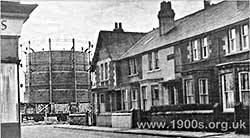
Medium-sized working, gasometer expanded with coal gas from a gasworks in the first part of the 20th century, courtesy of John Cronin.
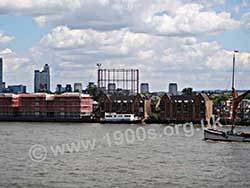
View across the Thames at London docklands showing the shell of an old gasometer. Photo taken in 2014.
Design and construction of gasometers
The massive metal storage tank of the gasometer had smaller cylindrical tanks fitted inside, rather like the sections of a telescope. As the gas was pumped in, these tanks rose into the sky and rotated slightly in the process. Rubber gaskets sealed the sections.
With demand for gas during the day, mainly from industry, the gasometer slowly and visibly decreased in height.
Peter Johnson
Did gasometers 'expand'?
I used to watch gasometers growing and contracting inside their metal frames. The gas looked as if it was inside an enormous balloon, and I used to worry that the balloon must soon burst, even though it never did. Only later did I find out that the gas was not in a balloon, but in a large diameter dome in a pit of water. As the gas entered the dome, the pressure forced it up.
Gasometers dates
Records date some gasometers to the late 1800s, and they featured much later in my childhood in the 1940s where the local gasometer was close to Canons Park Tube station at the cross-roads of Whitchurch Lane, Marsh Lane, Honeypot Lane and Wemborough Road. With naturual gas, gasometers became things of the past. This was in the 1960s.
A gasometer catches fire
During a German air raid in World War Two, a bomb went through the top of one of the gasometers in the gasworks along Angel Road, Edmonton, about a mile due east of us. As you can imagine, the flames shot several hundreds of feet up into the air. Quite a sight!
John Cole
Gasworks
Gasworks were factories which produce coal gas and coke from coal and they existed in most districts - such was the need for coal gas. They were located near railway lines as the coal had to be transported from the northern coal mines.
How gas was made - and its bi-products of coke and smokeless fuel
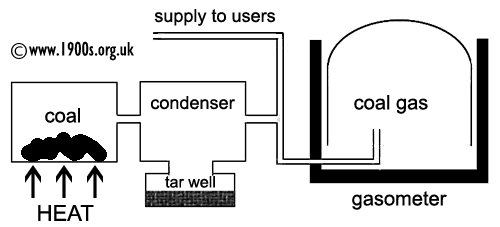
Process of the production of coal gas - a schematic, not to scale
The first step in making coal gas at the gasworks was to load coal into a large container which was sealed from the outside air and with a pipe to take away the gas that would be produced.
As the coal was heated, hydrogen, methane, carbon monoxide and other gaseous compounds were produced because there was no air to burn the coal completely.
The gaseous mix was then cooled in a condenser, leaving a gas and a tar-like substance which was drained off. The gas was sometimes given other treatments but was essentially 'coal gas'.
The coal gas was then stored in one or more gasometers.
Once cool, the remains of the coal were removed and the entire process was repeated with a fresh batch of coal. This was a semi-continuous process. Work never stopped, 24 hours a day, 7 days a week, up until the 1960s.
Coke and smokeless fuel
The remains of the coal had a changed appearance and was less dense. It was called coke and was sold onwards to householders as a fuel for burning. Coke burns well and produces less smoke. Indeed in later years it was described as a smokeless fuel.
Neil Cryer
Coal gas and poison
COAL GAS IS NO LONGER AVAILABLE, AND DOMESTIC NATURAL GAS IS NOT POISONOUS!!
The partial burn meant that coal gas was largely the poisonous carbon monoxide which combines with oxygen in the air to form the harmless carbon dioxide. In an enclosed space it was therefore poisonous, and it could cause explosions if large quantities of unlit gas came into contact with a naked flame.
There were accidents and many an old film shows murders being committed by turning on a gas fire without lighting it, so letting the unburnt gas into the room. Also 'putting one's head in the gas oven' was the most widely known method of suicide because gas ovens were effectively in every household. It was a simple matter to block doors and windows and turn on the gas without lighting it.
Fortunately, coal gas was given a characteristic pungent smell so there was always warning of it escaping gas for anyone in a fit state to notice.
Coal gas in the air open air was no longer poisonous because the carbon monoxide had taken oxygen from the air to become carbon dioxide.
Health giving properties of coal gas?!
Although the air around gasworks was devoid of carbon monoxide, the fumes from the burn remained, giving the area a characteristic pungent smell. Some doctors thought this health-giving for the lungs. Certainly coal gas really was poisonous, but the pungency of the fumes around gas works did cause sudden, uncontrollable gasps of breath and coughing.
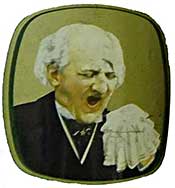
When I was a small boy in the 1950s, I had asthma and the remedy that the doctor prescribed was for me to be taken to a gasworks to inhale the fumes. My mother duly took me once a week by bus to Guildford gasworks where we were allowed to wander freely around, breathing in the 'health giving fumes'. Perhaps surprisingly I survived! Oh, and I now rarely have asthma attacks, so perhaps the cure worked!
Richard Cryer
Years ago a woman told me that when she was a child, a natural healer cured her of pneumonia by giving her kerosene* to breathe.
Nettie Clarke
*Kerosene is another name for paraffin oil which is actually more refined than kerosene so producing less soot, but the two names were often used interchangeably. It was also known in the past as lamp oil and coal oil. Like coal gas it has a characteristic pungent smell. Perhaps what was really regarded as healthy for lungs was breathing in pungent fumes of almost any source.
Natural gas, North Sea gas and the end of gasworks and gasometers
In the early 1960s 'natural gas', also known as 'North Sea gas', replaced coal gas. So gasometers and their associated gasworks became redundant. Over time they were largely taken down and sold for scrap. The shells of a few remain, like the one in the above photo which was small for its type. The metal struts give some idea of how large it must have been when it was inflated.
The widely publicised advantages of natural gas were that it wasn't poisonous like coal gas, and meant cleaner air.
Conversion of appliances from coal gas to natural gas
Appliances which worked on coal gas had to be converted to use natural gas. Many a family in our street complained that the oven conversions didn't work properly, and they were supplied with new ovens free of charge. That wasn't in my mother's nature, and she always complained that her oven didn't work as well after conversion.
If you can add anything to this page or provide a photo, I would be pleased if you would contact me.
Text and images are copyright
sources: early 20th century material
sources: ww2 home front and other material
contact
the webmaster/author/researcher/editor
privacy policy

