






 shopping
process early
20th century weights
and
measures old bakers
shops old butchers
shops old
fishmongers old grocers
shops old
Co-op shops old
dairies old
greengrocer
shops old sweet
shops


Shopping before supermarkets, early 1900s Britain

Shopping was time-consuming and labour intensive in early 1900s Britain. This page explains. It also comments on the pre-decimal currency involved, how goods were wrapped and shop opening hours.
____
Extracted from the memoirs of the webmaster's mother(1906-2002) and edited by the webmaster with further research and firsthand contributions from others
Location of shops
Women shopped locally for everyday items when I was a child in the early 1900s, and I sometimes went with my mother to our local shops in Edmonton. (Never with my father, as it was unheard of for men to be seen doing women's work.)
Prices of goods
We paid in pounds, shillings and pence, i.e. £-s-d. In practice, though, most things we ever bought in the early 1900s only cost a few coppers. More expensive things were normally priced at a penny below the next shilling. For how these prices were displayed in shop windows, written in handwriting and pronounced, see the separate pages.
Why shopping was time-consuming
There were no supermarkets to sell everything in one visit. So we had to go to all sorts if different shops - see the above menu. So shopping was a lengthy business. This was especially so because everyone was served individually and had to wait while the shopkeeper went to get or take out every single item. Also many of the goods had to be weighed and wrapped for each customer, and social chit-chat was expected. It was, though, quite interesting for me to stand and watch the shopkeepers rapidly manipulating the weights on the scales as we waited in turn to be served. They did it so quickly and they always seemed to get it nearly right just from size alone.
Why shopping was labour-intensive
Quite apart from the time that shopping took, it really was hard physical work. This was because we had no cars to carry our purchases back home, and the wickerwork baskets were heavy even before anything was put in them. It was common to have to go out several times, just because people couldn't carry what they needed in one go.
Fortunately it was common for shops to deliver. It was also common to send children on small errands. I often had to go and pick something up when my mother ran out. No one paid any attention to whether this was safe, but it probably was. Small corner shops meant that children just had to walk down the road without crossing it. If they did have to cross, traffic was light in side roads and slow moving at the walking pace of the horses.
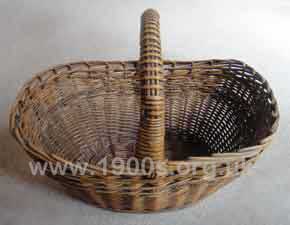
Wickerwork (cane) shopping basket. Such baskets were heavy even when empty, made in the early 1900s by a professional basket maker, courtesy of Richard Cole.
How goods were wrapped
Note from the webmaster
My mother wrote nothing about how loose goods were wrapped, but I understand that that it was much as I remember in the early 1940s.
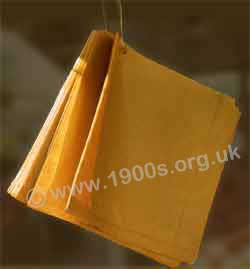
Paper bags on a string, ready for one to be torn off for use.
Some goods like potatoes were tipped straight into the customer's basket, suitably lined with newspaper.
Small goods were packed in white paper bags which were often printed with the name of the shop for publicity purposes - although this was an extravagance that could not be maintained later, during the austerity of the Second World War. Larger goods went into brown paper bags. The paper bags were supplied by the shopkeeper who kept them on a thin string and tore one off as it was needed.
Heavy goods went into sacks and were delivered.
In my mother's time in the early 1900s, children's sweets went into a cone of twisted newspaper, but I never saw this.
When shops were open
Why shops stayed open late on Saturdays
Men worked a five and a half day week and were paid on a Saturday morning. After that there was money in people's pockets. So shops would be open till perhaps 8 pm.
Bert Felgate
whose family owned a greengrocer shop
Shop buildings
Note from the webmaster
Although most of the shops were built as shops with flats above for the shop keepers, some shopkeepers opened shops from the front rooms of their Victorian/Edwardian terraced houses - see for example, the photo of the shop front in Leicester.
If you can add anything to this page or provide a photo, I would be pleased if you would contact me.
Text and images are copyright
sources: early 20th century material
sources: ww2 home front and other material
contact
the webmaster/author/researcher/editor
privacy policy

