





 shopping
process early
20th century weights
and
measures old bakers
shops old butchers
shops old
fishmongers old grocers
shops old
Co-op shops old
dairies old
greengrocer
shops old sweet
shops

Sweet shops (confectioners) and sweets, early 20th century UK
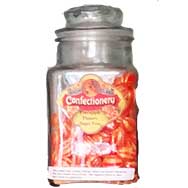
Sweets were popular and readily available in the in Victorian times and in the early years of the 20th Century. This page describes the sweet shops, also known as confectioners and the sweets that they sold.
____
Extracted from the memoirs of the webmaster's mother(1906-2002) and edited by the webmaster with further research
Inside early sweet shops
When I was a child in the early 1900s, sweet shops were popular, particularly for children.
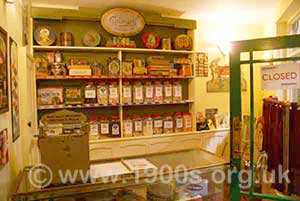
Reconstruction of a Victorian / Edwardian sweet shop in
Milestones Museum.
Items that one might expect to see in the
reconstruction seem to be missing, for example
scales to weigh out the sweets, but are in the following photo.
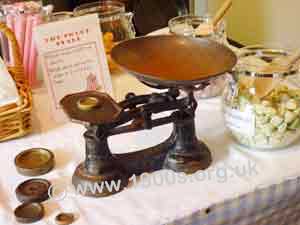
Manufacturers' sweets were sold from large glass jars stored on show on shelves behind the counter. It was amazing how many different flavours and colours there were and accordingly how many different glass jars were on display. The following photo gives the idea.
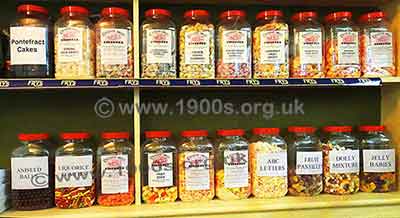
Jars showing their labels and thus the type of sweet on sale. Photographed in Cambridge and County Folk Museum. Being a reconstruction, some jars may come from the later than the early 1900s.
These jars were quite heavy, but the assistant would lift them down and weigh out whatever customers wanted. Then she would have to lift the heavy jars back up. Sometimes there was a short ladder which could be slid along a rail to get to the right position.
The range of sweets on sale
Sweet shops, like many other shops in the early 20th century were family owned which meant that some of what they sold was made on-site and not necessarily quite the same as in other sweet shops. For example, the sweet shop nearest my school sold triangular bags of broken wafer biscuits with a marshmallow fish on top.
There was another corner sweet shop which always had a large tray of home-made toffee on the counter. The shopkeeper would break it up with a small hammer and lift pieces out with small tongs.
There were all kinds of sweets regarded a specially for children, eg bull's eyes, pear drops, humbugs, liquorice sticks, etc - many of which show on the the labels of the jars in the larger original image (not provided here). It never occurred to anyone that sugar might be bad for our teeth. We children normally bought an ounce at a time and occasionally, if we could afford it, 2 ounces. Children's sweets were sold in a cone of twisted newspaper. Adult's sweets went into a white paper bag, usually with the name of the shop printed on it.
We never bought chocolate as wasn't around much if at all.
The sweet shop also sold tiger nuts. We children particularly liked the tiger nuts because they were so sweet, but they often had insects and grit in them. Surprisingly we never minded the insects at the time, but the grit could give teeth a nasty jar.
In the 1950s my husband suddenly announced that he hadn't seen tiger nuts for ages and as he had liked them so much as a boy, he was going to try to track some down. When he did, he came back and said how horrible they were and how he couldn't imagine how he had ever liked them.
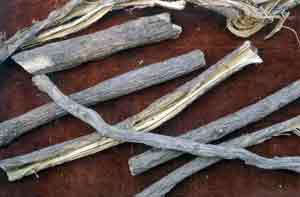
Liquorice sticks, photographed in the Apothecary Hall of the National Botanical Garden of Wales
Note from the webmaster
When I was young in the 1940s and 50s, sweet shops had hardly changed, apart of course during rationing.
If you can add anything to this page or provide a photo, I would be pleased if you would contact me.
Text and images are copyright
sources: early 20th century material
sources: ww2 home front and other material
contact
the webmaster/author/researcher/editor
privacy policy

