






 shopping
process early
20th century weights
and
measures old bakers
shops old butchers
shops old
fishmongers old grocers
shops old
Co-op shops old
dairies old
greengrocer
shops old sweet
shops

Bakers' shops/bakeries and their produce, early 20th century UK
Bakers’ shops, also known as bakeries, were generally family run businesses in the early 1900s. They baked on the premises and sold fruit cakes and biscuits as well as bread, but never cream cakes. This page illustrates a typical shop front, describes bakers’ work clothes and how they carried multiple loaves at a time. It goes on to explain the meanings of the terms 'makeweights' and 'bakers dozen', all brought to life through firsthand experiences and observations from the time.
____
Extracted from the memoirs of the webmaster's mother(1906-2002) and edited by the webmaster with further research and firsthand contributions from others
Baker's shops and bakeries
Baker's shops did a roaring trade when I was a child in the early 1900s. This was in addition to their almost continous deliveries.
The businesses were normally owned or worked by families, and the preparation and baking were always done behind or close to the shop, generally referred to as 'out back'. So you could smell a baker's shop as you approached, and it was wonderful. Outside, all sorts of appetising breads, cakes and pastries were displayed in the window.
Bakers' cakes
Bakers concentrated on various types of fruit cakes and biscuits. What I particularly remember were long rectangular shortbread biscuits with a cherry in the centre and something called rice cakes. These were very plain and had crystallised sugar sprinkled on top, again with a cherry in the centre. A significant number of bakers were German and they brought their baking skills with them, in particular the various spices in their cakes and bread. There were no cream cakes.
Bakers also specialised in more exotic fare. The following enlargement of the window of the bakery further down the page shows that they would produce to order beautifully iced and decorated wedding and birthday cakes, tired if required.
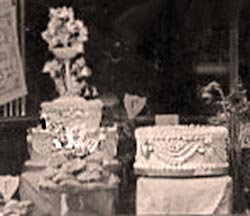
Iced, decorated and tiered cakes produced to order
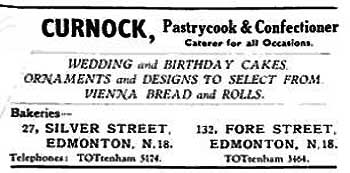
It is difficult to identify what other produce is in the shop window shown below. It is probably sweets of various sorts as the following advert states that the bakery was also a confectioner.
The baker and his bread
I really liked to see the baker come out of the area 'out-back' wearing a long white apron over his regular clothes and a white cap. I wish I had a photo to show you because what would be unusual by the norms of today was that he would be carrying a tray of loaves on his head. The smell of this freshly baked bread was wonderful, and we knew it would be lovely, crusty and tasty.
Most bread was white; there was some brown but white was much more popular.
Bread makeweights
During the 1914-18 war bread had to be sold by weight, rather than by loaf, so it had to be weighed. If the loaf was supposed to be two pounds, and it fell short, the shop had little squares of bread about two inches across that were called makeweights. Usually only one would ever be required. In those days when the children went to fetch the bread, it was quite normal for them to eat the makeweight on the way home.
The bakers dozen
Makeweights bring to mind the 'baker's dozen'. This was 13 of a baker's wares when a dozen, 12, was paid for. The practice seems to have passed into disuse today, unless you know differently.
Some typical bakers' shops
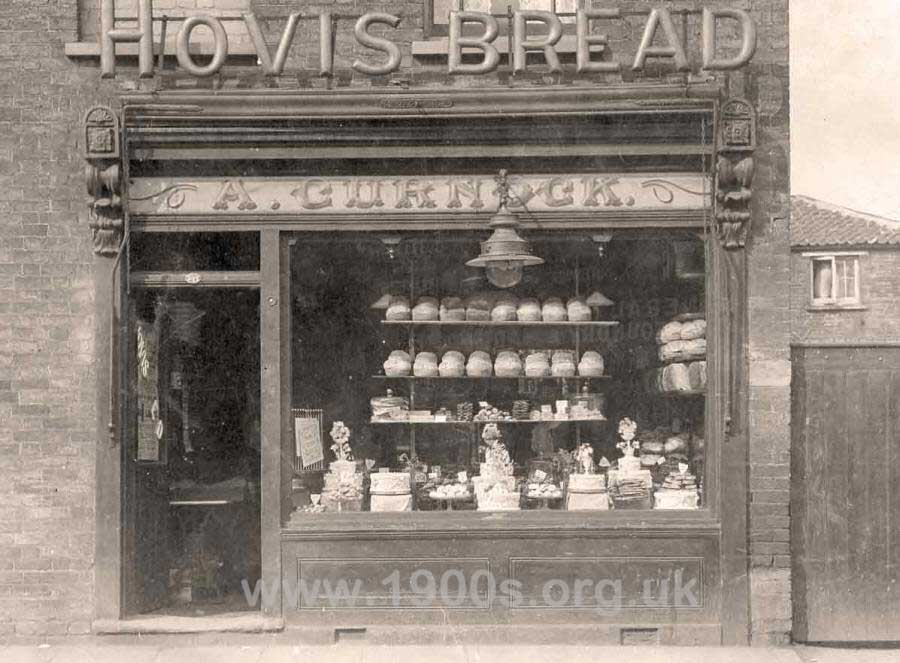
A typical bakery shop: Curnock's at 27 Silver Street about 1910. Note the gas lamp hanging over the shop window.
There were three bakers shops along Silver Street in my home town of Edmonton when I was a child in the early 1900s and two were owned by Germans which seems not to have been at all unusual in other towns.
Breyers Bakery
Bryers was a German bakery shop. I well remember the baker whose name sounded to me like Brayer. His wife served in the front of the shop and he would come in from the back where he had been baking carrying a tray of loaves on his head. He was very fat. His wife never made conversation and her appearance was like that of so many women of the time: a long skirt, tight bodice, hair loosely taken away from her face and coiled onto the top of her head in a bun. She kept the bun covered with a white bun cover.
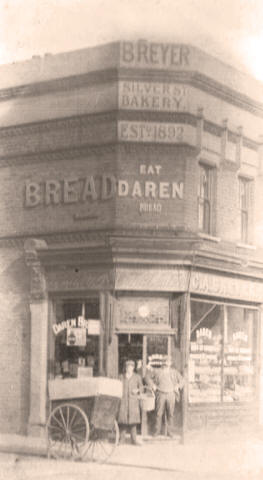
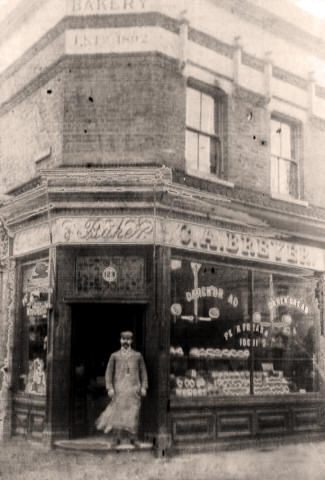
Two old photos of Breyers bakery shop, courtesy of the Scarff family
This bakery had a prime position. It was a 'corner shop' which meant that it was easy to get two from two roads rather than one.
Information on Breyer's bakers from the 1911 census
The 1911 census shows that my mother's memory was absolutely right:
Christian Breyer, 45, master baker, was born Kupfernzel Germany and lived at 123 Silver Street, (presumably above his shop) with his wife Ellen Elizabeth Breyer, 49, born Devizes, Wiltshire. No children were recorded but two servants assisted with the business.
By the late 1950s, Breyers bakers had gone and the shop was a funeral director's.
Ungerer's bakery
The name of this German baker sounded like Hungerer. He had an assistant who helped in the shop and I have good reason to remember her. One day I went in there with my friends and on the counter was a large tray of homemade toffee, broken up for sale. One of my friends said, "I dare you to take a piece". It wasn't like me, but as nobody seemed to be around, I did. In a flash the assistant appeared and said, "You can put that back." and, "I'll tell your father of you". I was really scared because I thought she really would tell my father who was well known in Edmonton. He was an ambulance driver for the hospital and nephew of E G Cole who was chair of the Board of Guardians and owner of the local Pottery. In fact she never did tell on me, but I lived in fear for days.
Information on Ungerer's bakers from the 1911 census
Note from the webmaster
The 1911 census again shows that my mother's memory was absolutely right:
Charles Ungerer, 43, baker and confectioner, a German resident, lived at 83 Silver Street with his wife Frances Ungerer, 37, born Pimlico, and their sons Christian, 13, born Southwark, Bernard, 9, born Southwark, Frank, 3, born Edmonton and Alice, 1, born Edmonton. Their daughter Amy, 5, was born in Edmonton. 83 Silver Street was part of the large houses in Pymmes Villas, so the family's shop must have been elsewhere in Silver Street.
Curnock's bakery
Note from the webmaster
The third baker in Silver Street was Curnocks. According to the 1911 census, Alfred John Kurnock (sic) of Edmonton was born about 1856 in the city of London, and his son, Earnest Alfred Curnock, was born in Edmonton about 1884. The family was therefore trading before my mother was born and was also trading for decades afterwards.
History of Curnock's bakeries
My grandfather Alfred Curnock took over the bakery premises at 27 Silver Street from James Kilsby in 1898, as is evidenced by the following documents.
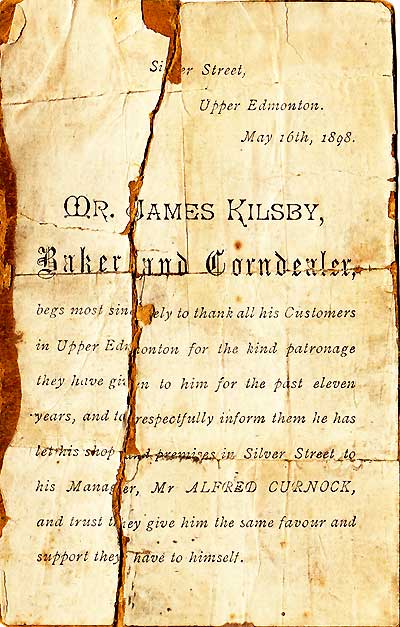
The family was still trading through the 1930s and they continued until the 1950s.
During this time, they had opened a second shop in Fore Street, Edmonton
Tony Curnock
And into the future
You may like to compare these early bakers shops with the bakers shops in the 1940s and WW2.
If you can add anything to this page or provide a photo, I would be pleased if you would contact me.
Text and images are copyright
sources: early 20th century material
sources: ww2 home front and other material
contact
the webmaster/author/researcher/editor
privacy policy

