 the
thefood safe keeping
short-life food
edible cooking pots
and
saucepans the Sunday
roast early
20th C weekly menus
early 20th
century everyday
meals early
20th C food in poor
families early
20th C better taste
in
the past? traditional
dripping traditional
roast
potatoes traditional
gravy traditional
roast
trimmings traditional
bubble and
squeak

Everyday meals, early 20th Century England
All the food that we ate when I was a child in the early years of the 20th Century was wholesome, filling and made from fresh food - and all the meals were cooked on the coal-fired cooking range. Menus were largely dictated by the day of the week, but there was scope for some variety. This page describes some of the traditional meals and how they were made. Recipes were not precise, but more of 'a bit of this' and 'a bit of that' based on experience of what had worked in the past.
____
Extracted from the memoirs of the webmaster's mother (1906-2002) and edited by the webmaster with further research and firsthand contributions from others
Meat pudding
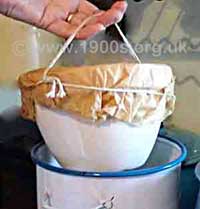
I really loved the meat pudding of my childhood. It was always made before I went to school in the morning from ¾ lb of leg of beef and a ½ of beef suet. My mother would make the suet dough; line a basin with it; cut the meat - always beef - into pieces; dust them with a mixture of flour and gravy powder; put them into the basin; add salt, pepper and water; put a thick crust of dough on top; secure a thin piece of white material over it with string; then draw the ends of the string together into a knot to form a handle.
A meat (always beef) pudding prepared for steaming in the style of the early 1900s. Note the china basin and the enamel saucepan.
Then the pudding would be placed in a saucepan of boiling in water for three to four hours. The pan was not allowed to boil dry, but neither was the boiling water allowed to seep into the pudding. When this did happen occasionally by accident, the suet pastry went soggy. The pudding was ready when we children came home for dinner at mid-day. By this time, the pudding was very hot, and the makeshift knotted handle saved my mother from getting burnt when she came to lift the pudding out and serve it up.
The richness and thickness of the gravy were superb. Try as I do, I never achieve the same results. It could have been the quality of the meat or perhaps the pudding needed to be of a certain size.
Pigs fry/tripe/offal
Pigs fry, also known as 'tripe and onions' was made in a large dish. The ingredients were sliced potatoes laid alternately with onion and pigs offal or tripe. Meat or vegetable stock from a previous cooking was poured over and the dish was left to simmer for several hours. My mother served it with other vegetables.
Tripe, which is the lining of pig's stomach, is almost white with a cell-like structure and is an acquired taste. Few people actually like it; in fact the word 'tripe' is a colloquial work for 'rubbish'.
What tripe is like to eat
contributed by Albert Smith, personal experience
Eating tripe is like chewing rubber.
Soups
Vegetable soup was another meal that could be left on the hob to cook for hours. This traditional soup was a meal in itself. It was not just thin liquid. There were lots of pieces of vegetable and sometimes pieces of meat where any was left over from the roast. If there was no left-over meat, women would buy bones to flavour the soup.
Rice pudding
I loved my mother's rice puddings. She put rice, water and milk into a large enamel dish with some sugar, a knob of butter and some grated nutmeg. Then the whole thing simmered for hours, and by the time we children came home from school, it was thick and creamy. Also a skin developed which I really liked, although not many people did.
Toast
There were of course no electric toasters. So to make toast, the bread always had to be toasted in front of a real fire, which for our family meant against the bars of the kitchen range in the kitchen.
There were special toasting forks for the purpose with long handles, so that our hands didn't get too close to the fire. Some of these toasting forks were rather decorative affairs made of brass. They usually had a design like a crest on them for a particular holiday resort or something similar. Wealthier families brought them back from holidays as souvenirs, just as less affluent families brought back sticks of rock with the name of the resort marked throughout. Consequently better-off families tended to accumulate toasting forks which was how they found their way down to the likes of us. Ours was used constantly.

Typical brass souvenir toasting fork. Note the long handle to keep hands away from the heat.
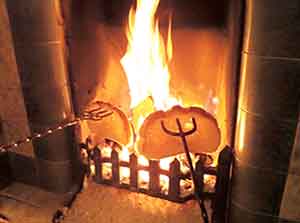
The bread of course had to be toasted one side at a time and one slice at a time, and it relied on the hot glowing coals of a coal fire. So the lumps of coal were turned over with the poker or tongs to expose the inner glowing sides from the heart of the fire. This also got the bread away from the smoke and flames of the fire.
Test your understanding: what's wrong with this picture
TEST YOURSELF
Is this a good representation of how toast used to be made?
No, the toast would taste of smoke and quickly burn. As explained above text, the coals were first turned over to expose the white-hot or red-hot embers, with no flames. Also there was usually only room for one slice to be toasted at a time.
By the time that several slices of toast had been made, the first slices were getting cold. So toast tended to be a snack for one or two people rather than a family meal. It was particularly good with the beef dripping from the Sunday roast.
When gas fires started coming in around the late 1930s, they were ideal for making toast, but a toasting fork was still needed to keep oneself away from the heat. Electric toasters were considered new fangled and only for the wealthy.
| sources | webmaster | contact |
Text and images are copyright
If you can add anything to this page or provide a photo, please contact me.

