
author logo, Pat Cryer, webmaster
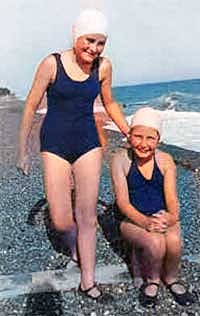
The webmaster, Pat Cryer, as a child

Random recollections of 1940s England

Visits to the seaside

My parents took me to the seaside on rare occasions during World War Two. Presumably my father was on leave, or perhaps it was shortly after the war. We went because my mother liked the sea air. But the beaches were mined and barbed wire prevented entry. It took a number of years to clear them after the war. So children of my generation grew up without ever paddling or swimming in the sea.

to top of page

Foxes

It was quite rare to see a fox when I was a child, even when walking in open countryside in rural areas. We did see them, but it was a talking point, "Look everyone, a fox!". As soon as the fox saw us, it would stand stock still for an instance and then dart rapidly away in the opposite direction or behind a bush. This was so even if we were already quite a distance away. Foxes were naturally scared of humans.

Foxes have changed since the 1940s and 50s. People laugh when I say this, but it is no joke. As I write in the second decade of the 21st century, foxes come into our back garden in increasing numbers. If they see us there, they still stand quite motionless, but now they glower directly at us, as if trying to stare us out. If we stare back, they eventually carry on calmly walking in their original direction. If we shoo, they do move fairly quickly away, but if we didn't see them in time to shoo, I am certain that they would come into the house. It is impossible to keep them out of the garden as I have seen them clamber over six foot fences, so we now have to keep downstairs windows shut.

As I write there have been several high profile cases of foxes biting humans inside their own houses.

to top of page

Red squirrels

In my childhood in the 1940s it was entirely normal to see red squirrels scampering around; not a grey squirrel was ever in sight. This was in the relatively rural areas of north London.

to top of page

Men doffing their hats to women

When out of army uniform, my father, like all men at that time wore a dark beige hat that was typical of the time. It was called a 'trilby'. When out in the street and passing a woman he knew, he would always touch it in a type of salute. I think this was a leftover from previous generations when men doffed their hats to ladies. By the 1940s, though, doffing had degenerated into a mere token, but it was nevertheless a normality as all the men seemed to do it.

Incidentally my father would never have referred to any female he knew as a 'woman'. She was always a 'lady'.

to top of page

Retail Price Maintenance

All identical items cost the same in all shops, even off-ration goods. This was known as Retail Price Maintenance (RPM), and I suppose it was an attempt to be fair to everyone. Shopkeepers didn't like it and I had assumed that this was because they wanted to charge more, so as to increase their profit. In fact the reverse was true. Many wanted to charge less to increase their trade.

Shopkeepers found ways round RPM. The one I personally knew of was percentage reductions for members of particular organisations, and even into the 1960s my husband and I furnished our home using it. Retail Price Maintenance was discontinued soon afterwards.

to top of page

ice skating

In the very harsh winter of 1947, crowds of people went ice-skating on the local pond. I am now confident that it must have been dangerous to commit the weight of so many people to pond ice, but apparently they got away with it.

to top of page

Pressure cookers

When we set up home in 1962 we also considered ourselves very modern to have a pressure cooker. Pressure cookers cooked food much more quickly than ordinary boiling would have done, because, being under pressure, the water boiled at a higher temperature. The most common form of pressure cooker produced this high pressure with a tightly fitting lid, with a small opening in it, with a weight on top, but there were other types.

In some ways, pressure cookers were dangerous, because if the valve outlet got clogged up, the pressure would rise dangerously high and the whole cooker would explode. Nevertheless, we used ours a great deal. Potatoes of a size that would take half an hour to cook by regular boiling, would cook in only 6 minutes.

With the advent of microwave cookers, pressure cookers became redundant.

to top of page

The best time to have been born and grow up

If you have an old photo which would illustrate the way of life described on this page, I would very much appreciate a copy. Pat Cryer

I believe that I was extremely lucky to grow up in the 1940s and early 1950s. Life never felt hard, and children were provided with the best possible of advantages:

A few years earlier and my generation would have been required to risk their lives fighting; there would have been no NHS, no free grammar schools, and no grants for university. There was a period of turmoil after the war while things were settling down. So our education would surely have suffered.

A few years later, with the deterioration of grants, I doubt if my father would ever have afforded to send me to university. I have been very lucky and am all too aware that others were less so.

to top of page

This website Join me in the 1900s is also known as Join me in the 1900's and is © Pat Cryer.

The 1940s and 1950s are also written as the 1940's and 1950's.

SEE MORE ON 'DAILY LIFE' FROM THE MAIN MENU