 WW1
WW1conscription &
exemption filling WW1
servicemen's
jobs WW1
munitions
factories WW1
patriotism an
propaganda rationing and
shortages in
WW1 air raids
in WW1 wounded
soldiers
return patriotic
WW1
posters armistice
celebration
and peace

Wounded WW1 soldiers return to military hospitals
As the enormous number of casualties were brought back from overseas, they were placed for recovery in a number of military hospitals set up across the country. This page is about one of them which is probably fairly typical of them all. It includes how children lined the streets to welcome their heros, the hospital buildings, the clothes for the patients and the nurses' uniforms, the wards, the limitations of treatment and much more.
____
Extracted from the memoirs of the webmaster's mother (1906-2002) and edited by the webmaster with further research
The arrival of the wounded soldiers
We children were always excited when a convoy of wounded soldiers was expected. They had been brought back to England by ship, then by train to a London Station where ambulances met the convoys. My father was one of the ambulance drivers.
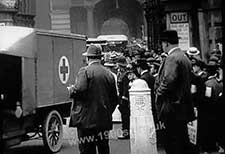
Convoy of ambulances leaving a London station transporting wounded WW1 soldiers to the military hospitals
The ambulances moved only at a slow walking pace to try to prevent unnecessary jarring, as many of the soldiers were extremely badly wounded. When we children saw them coming along Silver Street, we would run along beside them and cheer.
The public were also quick to care for the new arrivals when necessary as clear from the recollection in the following box.
Everyone rallies round the new arrivals
"On Monday a train load of wounded men arrived at Swindon [presumably another hospital]. Being a Bank Holiday food was a difficulty, especially bread. However Stephens the baker got to work and got his ovens going, but we had to GIVE the bread as it is illegal to SELL bread till it is twelve hours old."
from a WW1 letter in 'Charlotte's Beastly War' by James Melik, reproduced with permission
Military Hospitals in WW1
There were several hospitals in England given over to the care of wounded soldiers during the First World War. They were similar in how they were run except that each had its own specialisation. I knew Edmonton Military Hospital as it was close to where I lived. It was a special surgical hospital for orthopaedic cases.
The Military Hospital was a great centre of interest to local people with its two large red crosses on the front gates.
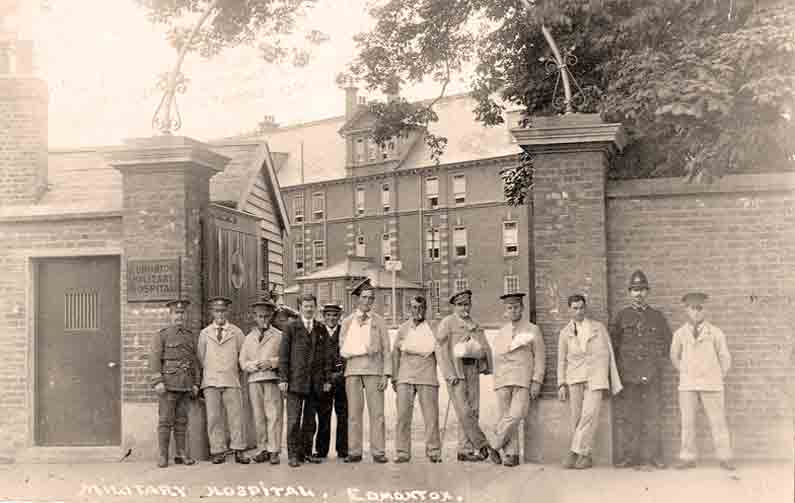
Edmonton Military Hospital, during World War One*. Note the cross on the left-hand gate.
The Military Hospital in Edmonton must have been fairly typical of other military hospitals in England. It was in Silver Street, Edmonton and is now the North Middlesex Hospital. My father's uncle, E. G. Cole, was very much involved in setting up the hospital for military use, for which he was awarded an MBE.
There seem to have been several large buildings within the hospital site because, although all the photos on this page were taken and labelled either during WW1 or shortly afterwards, they do not appear to show the same building.
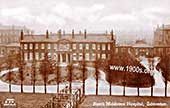
The front of Edmonton Military Hospital, from inside the main gate**
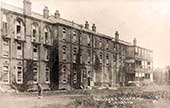
The back of Edmonton Military Hospital*
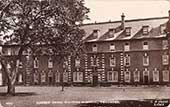
The nurses home at Edmonton Military Hospital******
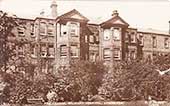
The annex at Edmonton Military Hospital******
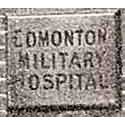
Plaque outside Edmonton Military Hospital
The wards and the nurses
The following photo is an example of the wards and the nurses. It shows the size and nature of a typical ward, its bed and the nurses. There more photos of the nurses and their uniforms below. As they will show, the nurses took part in the social life of the men, and look happy to do it.
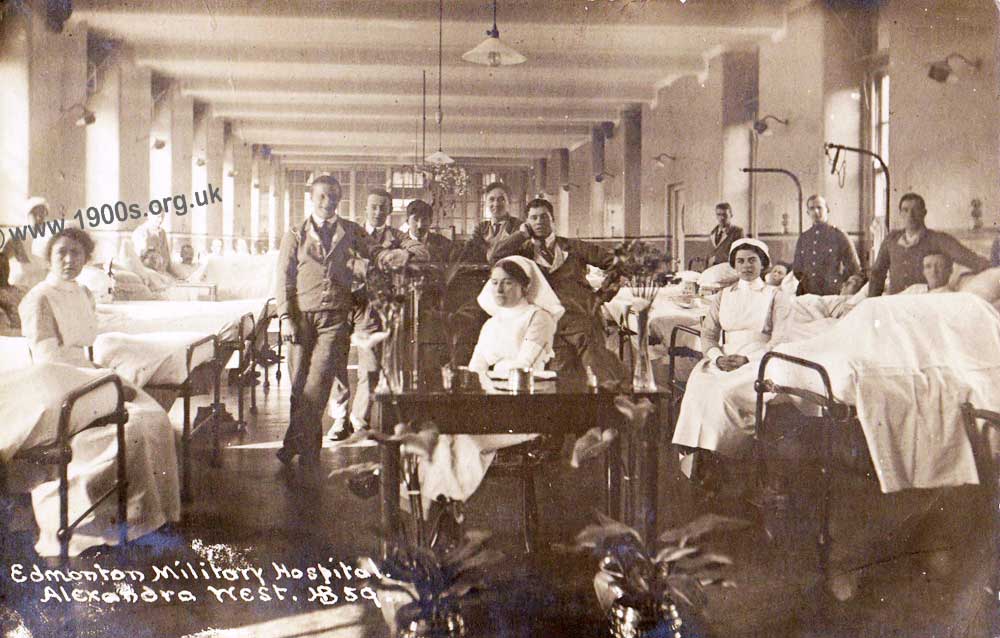
Alexandra West Ward**.
The hospital uniforms for the recovering soldiers
When the wounded soldiers were well enough to get out of bed, they were given hospital uniforms.
When the wounded soldiers were well enough to go out, they were very noticeable in the street as they were dressed in sax blue suits made of what looked like a type of lightweight flannel material, and they wore bright red ties.
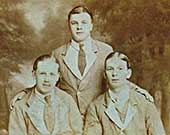
It seems that all the country's main military hospitals had the same uniform, as shown by the photo of Caenshill Military Hospital.
Uniform of the wounded soldiers***.
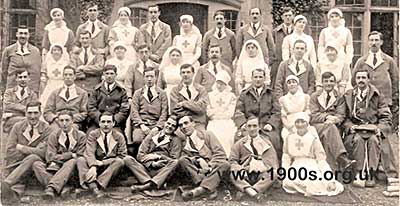
Nurses and soldiers at Caenshill Military Hospital the First World War showing their uniforms which are identical to those of Edmonton Military Hospital****.
Entertainment and social life for the recovering men
I have collected a number of photos of nurses joining in with the social life of the recuperating men. The following photographs show the uniforms of the various grades of nurse, as well as the suits worn by those patients who were well enough get dressed.
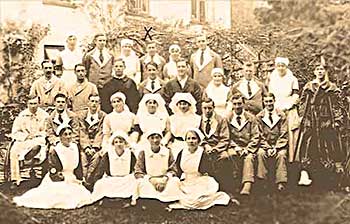
Wounded soldiers and nurses of Edmonton Military Hospital as guests at a wedding party in a nearby house, 1918***** .
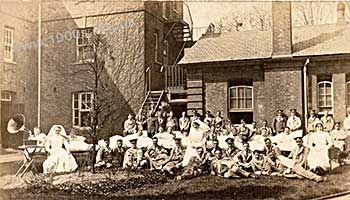
Soldiers relaxing in the hospital garden. Note the old wind-up gramophone on the far left with its speaker horn**.
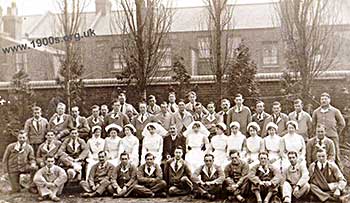
A group of soldiers in the hospital garden** The man in the centre, out of uniform, was probably a doctor.
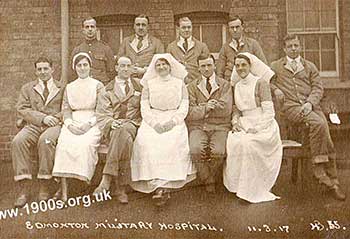
A select group of soldiers and nurses. The date is shown as 11th March 1917**
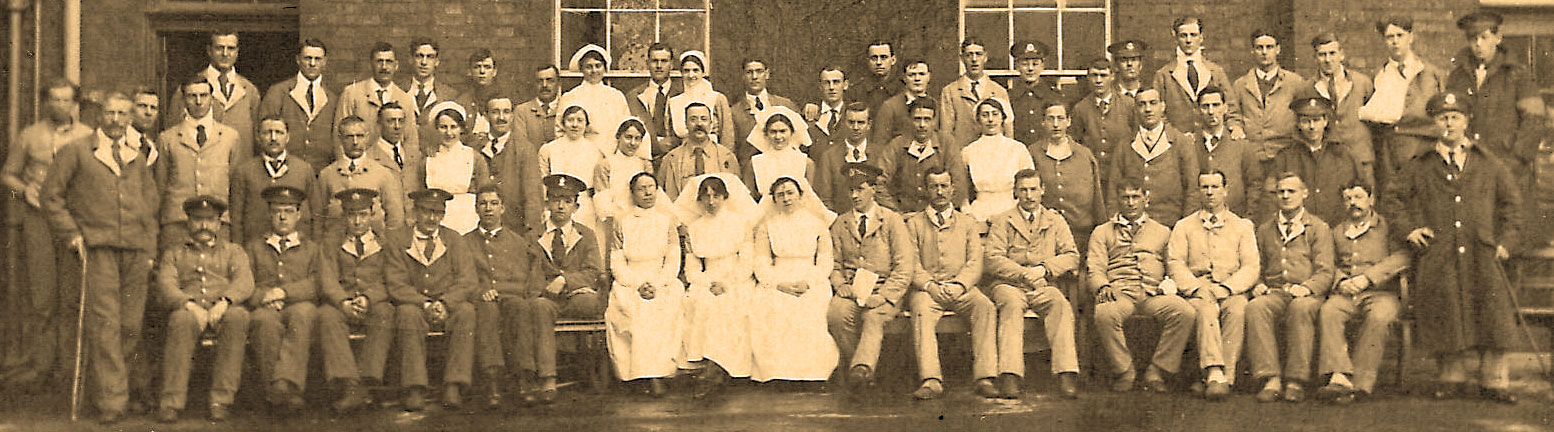
A group of recuperating soldiers and nurses at Edmonton Military Hospital, 1918******
The man standing at the centre looks like a doctor as he is out of uniform
Support for the wounded soldiers
Naturally everyone was very kind to the wounded soldiers. America sent tins of tobacco which were very attractive. They were about three inches long and curved to fit comfortably into a breast pocket. The name on the tin was Tuxedo and there was a picture of a man in a dinner jacket. The Americans also sent grapefruit, and my father had some, presumably a perk of the job. We had never seen them before and tried to eat them like oranges. So we didn't like them at all because they were so bitter.
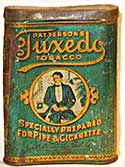
American Tuxedo tobacco tin, curved to fit comfortably into a man's breast pocket *******
The 'Peace Tea'
When the war was over, the hospital had a Peace Tea, and, as my father was on the staff, my mother and I were invited too. There was food galore and it was the first time I had trifle with sherry in it.
Memorabilia
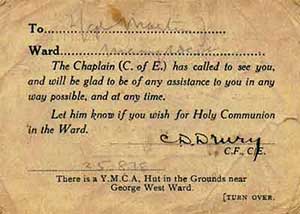
Visiting card of the hospital chaplain, C.D. Drury, dated 25 August 1915*** The recipient's name "Martin, J" is handwritten in the 'To' space.
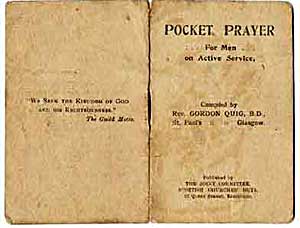
Gift from the hospital chaplain, C.D. Drury, dated 25 August 1915***.
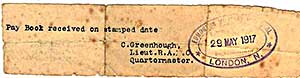
Rubber stamp of Edmonton Military Hospital, 1917******. Clearly the hospital held the soldiers' paybooks.
Limitations of treatment
Not all the wounded men were returned to full health and strength
The hospitals did a great job of care, but the available medical technology was much less advanced than today.
What sticks in my mind from my 1930s childhood is the number of ex-servicemen from the First World War begging in the streets or playing musical instruments for donations. All had limbs missing or loss of sight.
contributed by Peter Johnson, childhood recollections
*Photo courtesy of Enfield Local Studies Centre and
Archive
**Photo courtesy of Tony Curnock
***Photo courtesy of Glenn Newson
****Photo courtesy of Lesley Ruse
*****Photo
courtesy of Bruce Robinson
******Photo contributed anonymously
*******Photographed by the webmaster at a show
| sources | webmaster | contact |
Text and images are copyright
If you can add anything to this page or provide a photo, please contact me.

