






 how the UK
was kept fed
in WW2 how rationing
worked
in WW2 retail price
maintenance Women's
Land Army:
land girls back garden
meat
farming back garden
vegetable plots from seeds
to crops wild game
for food pig swill from
food scrap
collections


Dig for Victory in the UK rationing and shortages of WW2
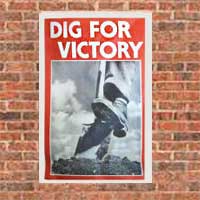
During World War Two, the UK Government did what it could to encourage the public to grow vegetables so that the country could become more self-sufficient for food. The campaign was known as Dig for Victory. This page is about the use of back gardens, allotments and less usual spaces that people planted and how they obtained the seeds.
____
By the webmaster: her early recollections with further research and contributions from others who lived at the time
The Dig for Victory campaign
One of the spearheads of the Government campaign to make Britain more self-sufficient for food in World War Two was to encourage the public to grow vegetables in their gardens other available spaces such as allotments.
This feature of the wider campaign was called Dig for Victory. Rationing was so severe that householders needed little encouragement grow their own.
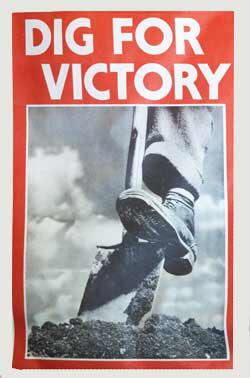
DIG FOR VICTORY poster photographed at Swansea Bay Museum
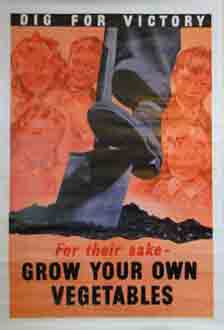
Photographed in the Museum of Nottingham Life
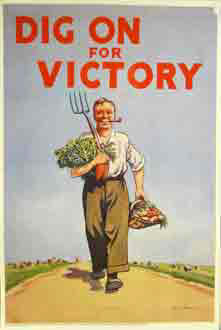
DIG ON FOR VICTORY poster photographed at Swansea Bay Museum
Posters encouraging everyone to grow as much of their own produce as possible
Spaces used for planting for the Dig for Victory campaign
Back gardens
Like many other back gardens, my parents' back garden was turned into a vegetable patch. We also had two fruit trees, a cooking apple and an eating apple, and they fruited well.
It was sad to get rid of the lawn and flowers, but I remember my parents' euphoria at the end of the war when we seeded a new lawn.
Empty plots and hedge rows
Some local houses were empty for the duration, or billeted with the military. (Ours were from RAF Kenley aerodrome). So to leave nothing wasted, we planted their gardens with spuds and sprouts and cabbages.
There was fruit from fruit trees in these gardens which otherwise would have gone to waste, and we made use of them.
We also collected blackberries and crab-apples from the hedgerows for pies and jams, although this required precious rationed sugar.
Tim Sesemann
Victory gardens
In the Allies countries, Victory Gardens was the name given to the spare areas of land used for growing food in wartime, but I don't remember the term ever being used in Britain at the time.
Neil Cryer
Buying and obtaining seeds WW2 Britain
I don't ever remember flower seeds being sold formally during World War Two.
Vegetable seeds could be bought from seed merchant shops, which were in most high streets, and from allotment association shops.
The seeds became available around the times when they needed to be sown and not at other times of the year.
There were no packets of seeds. The shops had their seeds in large containers. Small seeds were sold by weight and large seeds such as peas, broad beans and runner beans were sold by the pint. They were weighed or measured out and sold in brown paper bags.
Seeds were not rationed, but they were not always in good supply.
Seed potatoes were available in the spring at seed merchants and in Woolworths. The shop would place a notice in the window saying when the seed potatoes were to be sold and everybody got there early and stood in a queue, waiting for the shop to open. Seed potatoes were not rationed as such, but you had to queue up for ages - and once the shop was sold out that was it.
Peter Johnson
As the recollections in this box are from the area around Edmonton in north London where Peter Johnson lived, the seed merchants were probably the corn chandlers that my mother wrote about there in the early 1900s.
Pat Cryer, webmaster
Peter Johnson's recollections jolt my memory in that I do just remember my father belonging to the local Allotment Association, where he presumably bought seeds. Whether this was in the early years of the war before he was called up into the army - when I was still only a toddler - or just after the war when rationing and shortages were even more severe, I cannot be sure.
I don't think that there were seed merchants shops in Edgware where I grew up, but it was a relatively new community which was part of the expansion of the suburban commuter belt in the 1930s. Peter Johnson mentions Woolworths, and I remember that from the late 1940s it had a very good and cheap gardening section in Edgware. My mother bought many of her plants and bulbs there.
There was a small nursery in Edgware, opposite the British Restaurant (the site that later became the public library), but I only remember it vaguely because it closed quite soon after the war.
Saving and swapping seeds
Rather than relying on finding a shop that might have seeds to sell, it was common practice to save some from the previous year and to swap with friends and neighbours. This was particularly true of flower seeds which were not available to buy in wartime.
Saving seeds required leaving one or more plant to flower and set seed. At this stage, they looked quite tatty. Nevertheless it was important to wait until all the sap had left the seed case so that the seeds were quite dry. Then they were collected and stored in labelled brown paper envelopes. In the 1940s, there were no plastic bags, but even if there had been, they would not have been suitable for storing seeds. Plastic 'sweats', whereas the paper bags were slightly absorbent, so keeping the seeds dry.
The envelopes of seeds were kept somewhere free from mice and reasonably dry to over-winter. Damp seed goes mouldy and is no longer viable.
Saving seeds worked well because few if any seeds were hybrid. Hybrid seeds are specially produced each year, and are common in today's seed catalogues because they are said to give better quality results. However, saved hybrid seeds do not come true to the parent plant, so need to be bought fresh every year.
Why growing vegetables didn't always work
Pests - human and other
My mother's brother, on a twenty-four hour leave from the RAF, dug up our entire front garden and planted neat rows of cabbage plants which grew magnificently with the help of steaming manure from the milkman's horse. (It was my job to rush out and scoop that up with a coal-shovel before any of the neighbours got there first!)
One morning, when my mother pulled back the blackout curtains, the entire crop had been 'lifted' during the night! Granny said she strongly suspected that it was the work of one of the neighbours who was believed to have had a vegetable stall in Woolwich Market. She cursed the 'culprit' for years afterwards.
Michael Sullivan
My husband's relative thought he would make the family more self-sufficient for food by growing vegetables and keeping a goat for milk. He kept the two apart with a fence. One day, though, the goat managed to get through the fence - and that was the end of the vegetables!
Marina Theophanopoulos
Fortunately garden pests were not as serious as they are today. Does this surprise you? Grey squirrels had not yet arrived in any numbers and foxes were also few and far between. Any stray rabbits in gardens would have been shot for food and as far as I know there were no laws preventing destructive badgers being killed. Insect pests were quite successfully sprayed with soapy water. If you know more, please contact me.
If you can add anything to this page or provide a photo, I would be pleased if you would contact me.
Text and images are copyright
sources: early 20th century material
sources: ww2 home front and other material
contact
the webmaster/author/researcher/editor
privacy policy

