






 Saturday morning pictures, early
developments: pre-digital
Saturday morning pics 1940s50s
cinemas mid 20th century
inside cinemas mid 20th century
cinema
Saturday morning pictures, early
developments: pre-digital
Saturday morning pics 1940s50s
cinemas mid 20th century
inside cinemas mid 20th century
cinemanews cinema programmes and films cinema usherettes behind scenes
in cinemas mid 20th C closure of cinemas


Picture palaces and 'the pictures' in the heyday of cinemas
Ways of saying 'Going to the cinema'
When I grew up in the 1940s and 1950s, no-one ever spoke of 'going to the cinema' or 'going to the movies' or even 'seeing a film'. It was always 'going to the pictures'. I don't think I properly registered the word 'cinema' until the late 1950s. Older people still spoke of 'picture palaces' or 'picture houses'.
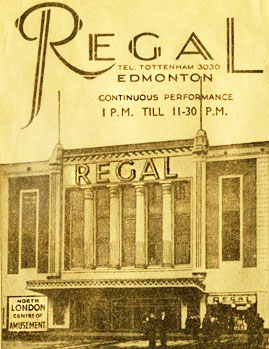
The Regal, Edmonton, courtesy of David Daniells
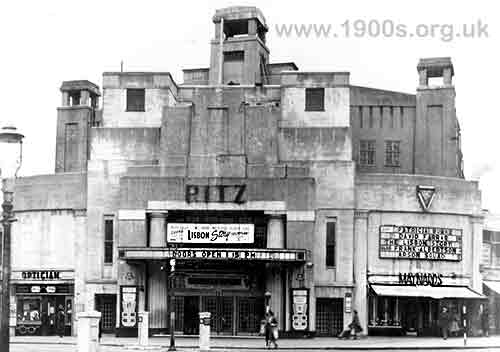
The Ritz cinema, Edgware
National groups or circuits of cinemas
Where I lived in Edgware, north London, our cinema was at the corner of Station Road and Manor Park Crescent. It was called The Ritz, and that is how we always referred to it.
There were, though, several national groups of cinemas, with each group showing the same programme at the same time, normally for a week. The main ones I remember were ABC, Gaumont, Odeon and Savoy.
So if a programme at one cinema didn't happen to appeal, there was always another cinema, belonging to another group, not far away.
Our Edgware Ritz was part of the ABC group.
Why cinemas were so popular
Going to the pictures was extremely popular as there was nothing similar at home because ordinary families didn't yet have televisions. Even in the late 1950s as televisions trickled into homes, the screens were tiny and the choice was small. Going to the pictures was an outing for young and old alike. So most towns and large villages had their own cinema.
Cinema visits as a treat for children
In the 1940s I went to the pictures with my mother, who always took me as a treat on the last afternoon of the school holidays. In the 1950s I went with my friends in the evenings. In the late 1940s and early 1950s I also went to Saturday Morning Pictures.
Film stars
This was the heyday of Hollywood and many of the actors who always seemed to be known as 'film stars' were household names. I collected their photographs by posting off requests to the production companies in Hollywood and invariably received a large signed photographs in return. At least, I thought they were signed, although the signatures were probably reproduction. I often received unsolicited autographed photographs too. I am surprised that this was regarded as a cost-effective form of advertising, but it certainly happened.
If you can add anything to this page or provide a photo, I would be pleased if you would contact me.
Text and images are copyright
sources: early 20th century material
sources: ww2 home front and other material
contact
the webmaster/author/researcher/editor
privacy policy

