





 social aspects
of
shopping packaging customer waiting alerts post offices shoe shops wool shops department stores Green Shield stamps other
shops


How shops wrapped and packaged goods in the past
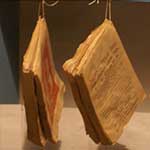
The packaging of shop goods changed little until the rationing and shortages of World War Two forced new ways of doing things. Some goods were still packaged at the point of sale, but a steadily increasing number arrived ready-packaged by suppliers and manufacturers. This page describes the early packaging in tins, cans, glass, stoneware and paper. There are generous descriptive images.
____
By the webmaster: as recollected from the 1940s and 50s, supported by firsthand contributions from others and discussions with museum staff.
Pre-packaging in tins
I was born a few months before World War Two and there were far, far more flat lidded tins around from before the war than there are today. It was never difficult for my friends and me to get hold of an empty and reasonably attractive lidded tin for craft or storing trinkets. The lids closed by simple pressure aided with a slight twist and squeeze and they opened with a similar twist and squeeze. They had been sold holding such things as tooth powder, solid 'cake' toothpaste, tobacco and much more.
The coloured pictures and text on the surfaces of the tins was generally produced using a process called lithography. I saw its applications a lot in my childhood, although of course I didn't know the name.
The process of colouring tins - lithography
Lithography involved using a flat metal plate or stone to transfer the coloured image onto a surface. It became popular in the 19th century for mass-producing colourful images for product packaging and other purposes.
The disadvantage of these tins was that the colourful outsides did scratch and rub off easily. Then they looked very shoddy, and few have survived today in their pristine form.
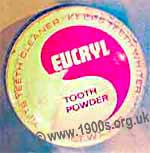
Small round tin of tooth powder with lid
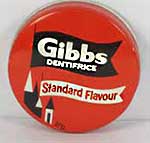
Small round tin of cake toothpaste with lid
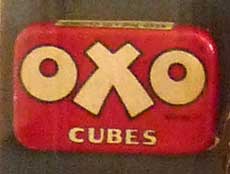
Fairly small rectangular tin of Oxo cubes with lid
As far as I know, once empty, these tins were put into dustbins along with other rubbish, i.e. not formally recycled - unless of course informally to store small oddments. They are seldom seen in shops today.
Larger tins with these lids are of course still seen today as, for example, biscuit tins.
There was also the prise-off type of lid. This was used for dry ingredients that were likely to spill. Most of us prised off the lids with the handle-end of a stout tea spoon.
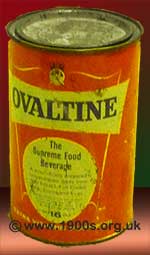
Tin with a lid that had to be prized off and could be pressed back on after use
Pre-packaging in closed tin cans for long-term storage
There were also tins - also known as cans - without removeable lids for long-term storage of fruit and other perishable foods which could be preserved in juice, oil or brine. They needed a tin-opener to open them.
The process of canning perishable food
The process of canning was developed in the early 19th century and, apart from certain refinements, the results are just as we see them on shop shelves today.
What tin cans are made of
Most 'tin cans' are not actually made entirely of tin. The tin is a thin lining to prevent the metal from corroding and spoiling the contents of the can. The thicker outside was usually made of steel or aluminium.
No canned food has survived in museums for obvious reasons. When people bought them, they opened them to use the contents. Then they were in no state to store. So instead of a photo, just imagine a tin of, say, apricots or pineapple today with rather more old-style writing on the label.
Pre-packaging in stoneware and glass
Stoneware has largely gone out of fashion today but it was used a great deal for holding liquids and jellies in the past, either because the contents would be heavy or to imply quality. A well-known example of stoneware is the old stoneware hot water bottle. I just remember a stone marmalade jar from the 1930s that had been washed out and put on display at home. Such jam and marmalade jars were quickly replaced by glass.
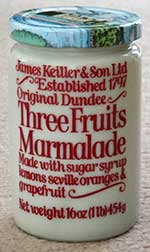
Stoneware jar of marmalade
Stoneware, often just called stone, is a certain type of clay or ceramic fired at a very high temperature and glazed so that it is impermeable and resembles polished stone.
Milk always came in glass bottles with crimped foil tops - a form of packaging that was attractive but easily spilt. Another page describes how to open the foil tops and the various uses to which they were put. Compared with today's waxed paper and plastic containers, bottles of milk were heavy.
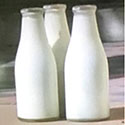
Glass milk bottles with silver foil crimped tops
Oils were sold in glass bottles either with screw tops or with cork stoppers.
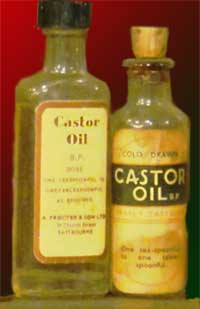
Glass bottles of oil, one with a screw top and the other with a cork stopper
Liquid poisons were always sold in ridged glass bottles, so that even blind people could tell that they were poisonous. The bottles were usually either green or brown which was an additional alert for sighted people. I understood that anyone could buy poisons as long as they signed a poison book, but there may have been restrictions that I didn't know about.
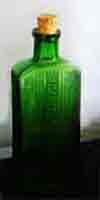
Ridged and coloured glass poison bottle.
I don't know how solid or powered poisons were sold. Do you?
All the toiletries that I knew in the 1940s and 50s were factory-made and sold ready-packaged by shops. Toothpaste was sold in metal tubes which customers could squeeze to get out the toothpaste, but which kept the squeezed shape afterwards. After numerous squeezes, the tube looked a mess and it was very difficult to empty it completely.
Packaging at the point of sale
Many goods were weighed or measured out and wrapped specially for every customer, just as they had been for years, usually in brown paper bags. Fatty foods were wrapped in greaseproof paper first.
Paper bags
Paper bags were the norm for packaging wherever possible, and they came in several sizes. If the stock was pre-war, the shop's name might be printed on the front. There were white ones and brown ones. A wad of them hung on a string and were torn off as required.
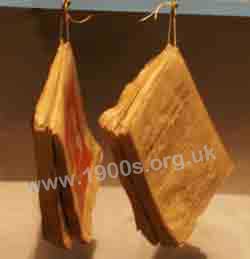
Brown paper bags on a string - common in shops in the 1940s. Photographed in Fagans Museum of Welsh Life.
Paper bags had a very limited life. They disintegrated if they got wet, either from holding damp produce or from rain, and they crumpled easily.
Biscuits were sold loose in paper bags for much of my childhood. This presented problems because they broke easily while being weighed out in the paper bags on the way home. In fact broken biscuits were sold off cheaply. It was very difficult indeed to keep biscuits crisp because they were continually exposed to the air in the shop before we ever got them, because the large supply tins had to be opened every time customers bought biscuits.
Butter was patted into shape, wrapped in greaseproof paper and sold in paper bags - see the Sainsbury's page.
Brown paper parcels
Boots the chemist wrapped goods in brown paper parcels, tied with string. They did this at the point of sale for every customer which was extremely labour intensive and slow. It was still going on in the late 1950s when I had a holiday job there.
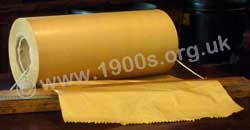
Brown paper roll used for wrapping purchases in Boots the chemist shops. Photographed in Fagans Museum of Welsh Life.
Doctor's prescriptions: pills, powders, ointments and liquids
Chemists/pharmacists made up doctor's prescriptions themselves. Pills were packaged in small brown glass bottles; ointments and powders in cardboard tubs with lids and liquids in glass bottles, invariably labelled as 'the mixture' irrespective of whatever happened to be in them. This form of packaging would have varied slightly from shop to shop.
The lack of packaging leads to shop smells
The lack of packaging in shops gave rise to something I recall with nostalgia from my childhood. It was the smell of shops: A grocer's shop smelled like a grocer's shop, a greengrocer's shop smelled like a greengrocer's and so on. The reason was that the food was open to the air. With the advent of almost entirely pre-sealed packaging in the 1950s and 60, all those wonderful aromas disappeared - and along with them, the individual character of the shops.
Jan Clifford
String bags for carrying packages home
When shopping baskets got overfilled, there were no plastic bags tucked away for emergency use. The answer was string bags. They were made of ordinary brown string woven into a fairly large open net with a string handle which didn't take up much space in a shopping basket. Being brown string, they always looked rather dirty and were accordingly popular for carrying vegetables, which were never sold ready-washed. Potatoes and carrots were the worse offenders. We always had to wash them at home before peeling them, and the water ended up black and gritty.
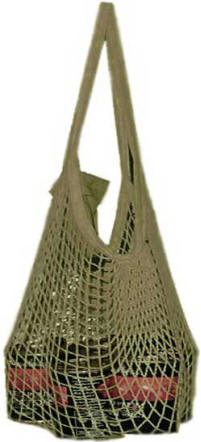
String shopping bag
String bags
Women also carried string bags for shopping. My mother's string bag would have the veggies in it, mostly in brown paper bags and it would then hang on the back of the pantry door with the vegetables in it ready to use.
Marilyn Ormson
String bags always had handles that were long enough to hang over the handles of prams or push chairs, so were easy to carry.
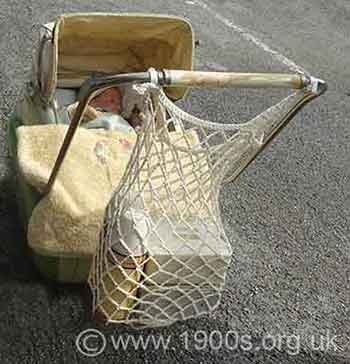
String bag carried over handle of pram or push chair
If you can add anything to this page or provide a photo, I would be pleased if you would contact me.
Text and images are copyright
sources: early 20th century material
sources: ww2 home front and other material
contact
the webmaster/author/researcher/editor
privacy policy

