






New state primary schools for 1930s suburbia
New state primary schools were built in the 1930s to serve young children in the then huge growth of suburban housing estates. These schools were for infants age 4 to 7 and juniors age 7 to 11. Today, the divisions differ slightly in different areas. This page is largely based on the webmaster's own experiences in Edgware in north London.
____
By the webmaster: her personal recollections of Edgware Primary School in the 1940s and class photographs
Why new schools were needed in the 1930s
New schools were needed to serve the children in the new suburban housing estates that were springing up around existing towns in the 1930s. My first school was typical. It was built in the 1930s as Edgware Primary School, although today Edgware Primary School refers to a different school in another building.
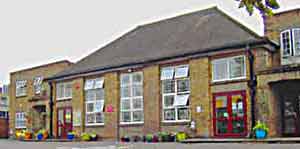
A 21st century photograph of what was Edgware Primary School, courtesy of Tony Woods
I started the school in 1944 while I was four years old and while the Second World War was still raging, and I left at 11 for my grammar school.
The school building
The building was quite small, but on a fairly large green-field site which was used for the underground Anderson shelters of the WW2 air-raids.
As you went into the school, there were cloakrooms on the left. On the right was the school hall which struck me, as a young child, as enormous. Seating was on the floor, although there were chairs at the side for the staff.
Classrooms were towards the back of the building and were reached from a corridor open to the elements on one side, and on its left was an open grassy area which was used for class photographs - and little else at that time. Further on was the headmaster's room.
There were more classrooms upstairs and presumably the staff room and storage facilities, but I don't remember much about them.
The playground
The main playground was in the front of the building, directly onto the main Edgware Road, which by today's standards seems rather strange because anyone could come in and interact with the children in whatever means they chose. As far as I know, there was no untoward activity. The reception class had their own playground at the back. Boys and girls played together in both playgrounds.
Parking facilities
I don't remember any facilities for parking cars which says a lot for the state of the traffic at the time, although the playground gates were wide enough to take the lorry which brought the school dinners. Children and staff either walked to school or used a bus". Children were seldom accompanied by an adult as it never occurred to anyone that it might be dangerous. I suppose there was some safety in numbers, and there was certainly almost no traffic around then because of the wartime petrol rationing.
The reception class, classroom and playground
The first class in 1944 was known as 'The Babies', and my teacher was Miss Reebold. That was how her name sounded, but I have no idea of the spelling.
Although the main playground was at the front of the school, we 'babies' had our own small grey stone-walled playground leading off our classroom. I always thought how neat and friendly it looked.
The classroom furniture was tables and small chairs.
Main classrooms
All the classrooms after the Reception year were simple large rooms, and the furniture was identical to what my mother described for the early 1900s classroom: a teacher's wooden high desk and chair, a wooden-framed blackboard and easel and two-seater desks for us children. (The term 'chalkboard' was effectively unheard of.) There were no tiers: all the classrooms were flat.
Although the classroom furniture for all but the reception class was of the Victorian style, it was all fresh and up-to-date, having been new only a few years before World War Two when there were no shortages or rationing and government money was not particularly tight.
The school lavatories
The lavatories deserve a special mention. What stands out in my memory is their floors. They, like other public lavatories of the time, were of a stone-like composite with particles that glistened in the light. I used to try to get to one of the 'sparklers' to pick it up, but by the time I reached it, the light was no longer on it and it had turned to dull grey stone.
The boys' and girls' lavatories were widely separated at different sides of the building
The lavatories themselves were low, so that the children's feet didn't dangle, and they flushed with a pull-chain. So things in the 1940s had improved since my mother's experience of school lavatories in the early 1900s!
Resources provided
As far as I remember most things we needed were supplied by the school, although I do remember the class being told to buy their own pens. By then, World War Two was raging, pens would not have been rationed, but money was tight, so I don't know what our mother's thought of even such a small financial outlay. These pens were the simple sort with detachable nibs, not fountain pens. The nibs at my school had to be a type called Jade4, which I particularly remember because the one that the shopkeeper sold me turned out not to be Jade4 even though I had been completely specific about what I needed. I suppose he was finding life hard and just wanted to make a sale, but I was really upset that he could be so unfair. Somehow I did get a Jade4 eventually. Ink for the pens was supplied by the school in non-spillable china pots let into the desks. You can see them on the far right of the pictures on the desks page.
The curriculum
I don't remember much about the curriculum, other than that in the final two years it seemed to be dedicated to getting children through what was called the 'scholarship', later called the '11-plus exam', for entry into a grammar school. In this it was very successful, largely due to a wonderful teacher.
Teachers' favourites
I used to wonder why certain children in my class were so obviously the teacher's favourites, as I couldn't see any difference between them and me or anyone else. One teacher would hug these favourites in front of the class and refer to them as "My Janet" and "My Jennifer".
Only later did I understand the reason. During the war and also once it was over, Britain was gripped with severe food shortages. The parents of the teacher's favourites happened to be managers of food shops. There was always extra food under the counter for those who storekeepers wanted to ingratiate themselves with - like their child's teacher. So of course, the teacher had to show the storekeepers that she really was being extra specially caring to the child. Yes, this was unfair, but if you never lived in those times, you cannot imagine how severe the food shortages were.
Checks on children absent from school
When a child was ill and off school, it was often for quite some time because the childhood illnesses like measles, mumps and whooping cough were rampant. As few households were on the phone, schools were seldom told why a child was absent.
To address this problem, there was a man - I don't know what he was called - who visited homes to document why children were absent. Our man was of indeterminate age and was probably in a reserved occupation. All I remember is that he seemed to spend his time with us, sitting round our kitchen table, probably drinking tea, and just complaining about the difficulties of the war.
School uniform
As you can see from the following photo of my class at my primary school, there was no school uniform. The children wore what their mothers were able to supply. Only later, after the wartime rationing and austerity were over, did school uniforms start for young children.
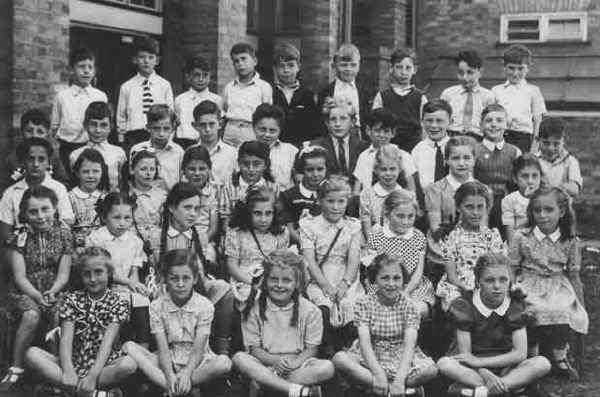
My class at Edgware Primary School when the children
look about six.
I never knew
how to spell their names, and their names here are as they sounded
to me.
Left to right
Back row: Christopher Cooper,
-, Harvey Selby, Michael Shiner, James Ballantyne, Stephen Newing, -, Stephen Golland,
Robert Levin.
Second from back row: -, Christopher Richardson (Kit), Roger Warrington,
David Arnold, Roy Boskin, Colin Brooks, -, -, Ian -,Tony Wilson.
Middle row: Rhona -, Janet Steele, Helen Davis,
Pamela -, -, Ann Dempsey, Brenda Mialls, Daphne Field, -.
Second row from front: Myra -, Hazel Waterfall, -, -, Janet
Saunders (Ginny), Pat Clarke (me), Jennifer Moss, Margaret Rennie.
Front row: Susan Knapp, Ann Rogers, Corrine Less,
Jean Breedon, Susan Turner.
Teachers
During the war, the fit, young men teachers were conscripted into the military. So the majority of teachers were either women, older men or men with certain health conditions.
The teachers at my school in the 1940s included Miss Reebold for the Reception year, Miss Ackroyd, Mrs Harmer, Miss Scutt, Mr Dashfield, Miss Sturdy, Mr Duckett, Miss Weinstock and Mr Perrett. The headmaster, Mr Bird, must have been in his fifties and probably in a reserved occupation.
A teacher's kindness
Miss Weinstock was my first teacher at Edgware Primary School and I always remember her kindness when Mr Bird summoned her to come and collect this very frightened little girl on her first day there, and how she held my hand all the way to the classroom and was kindness itself in helping me settle in to a new situation.
Sally Lawson (formerly Sally Porte)
I remember Mr Dashfield as a fairly young man. As he was not in the military, he could have been suffering from ill-health which might explain his fondness for punishment described in the following box.
A teacher's fondness for punishment
My one recollection of Mr Dashfield was his caning of four or five boys from a higher year group in front of our class. Perhaps he was standing in for our teacher. Subsequent to the punishment, one of the lads he caned stated that he had been innocent of whatever it was the lads were charged with. Mr Dashfield retorted that he should have said that earlier!
David Morris
If you can add anything to this page or provide a photo, I would be pleased if you would contact me.
Text and images are copyright
sources: early 20th century material
sources: ww2 home front and other material
contact
the webmaster/author/researcher/editor
privacy policy

