






 cleaning
sewing
darning
how to knit quickly and effortlessly
new
cleaning
sewing
darning
how to knit quickly and effortlessly
newknitting yarn from old knitting patterns and needles dealing with moth
damage men's work and
activities mending boots and shoes maintenance and decorating


The clothes moth, moth holes and moth balls
In the past, the clothes of working-class people were made of either wool, cotton or linen. There were no synthetic fabrics. Wool was the warmest and cheapest, so there was a lot of wool around. A problem with wool, though, was that there was a type of moth, known as the clothes moth, that attacked it, leaving unsightly holes. This page elaborates on the clothes moth and then describes moth balls, the only way available at the time to deter them. Finally it explains why they are seldom used today.
____
By the webmaster's mother (1906-2002) from firsthand observations, edited with further research by the webmaster
The clothes moth
Clothes moths were common in my childhood because conditions were absolutely right for them. They preferred the dark and relative coolness - just like inside the wardrobes of old, unheated houses, and wool was their preferred food - and everyone had woollen clothes because it was before the era of man-mad fibres. So everyone in my childhood would recognise a clothes moth because if left to its own devices, it could ruin clothes. They were quite different from the ordinary moths that we see today: they had a golden or buff-coloured body and paler fringed wings.
Damage caused by the clothes moth
Clothes moth attacks were most troublesome on clothes that had been put away in store for a while, like winter clothes over summer. The moth found them, they lay their eggs in them and ate little holes into them. Then when people got their clothes out to use, they found them spoilt. Commonly-heard description of the clothes were, "The moth has got into them" and "They've got the moth".
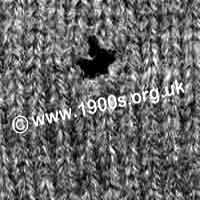
A moth hole in a knitted woollen garment
The holes could of course be darned, and they usually were, but the darning never looked like the original fabric. As most children wore hand-me-downs, it was quite common for their clothes to show numerous patches of darning.
Prevention of moth damage: moth balls
The only sure prevention of moth damage was for clothes not to be made of wool. However, this was easier said than done in the era before synthetic fabrics. Then, the best prevention - which was only partially successful - was to store clothes with what were known as 'moth balls'. These were white, semi-translucent balls about the size of marbles made of a pungent, somewhat crushable substance called naphthalene which had its own unique smell, said to deter or kill clothes moths.
Moth balls did work, but only to some extent because naphthalene fairly quickly turns into gas*, so you had to make sure that you replaced them frequently, spreading them evenly in the drawer or cupboard. Otherwise the moth came back and made more holes.
It was of course the women who bought the moth balls, but the task of spreading them was often given to us children.
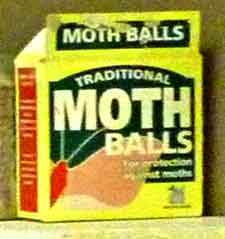
A packet of moth balls - or rather, a packet which once contained moth balls. Photographed in Swansea Bay Museum.
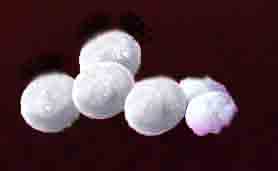
A mock-up picture from memory of moth balls. I have not been able to find any as they turn so quickly into gas.
Can you supply a genuine photo?
There were of course, no air-tight plastic bags to keep the moth at bay.
The ever-present smell of moth balls
The smell of moth balls was common because everyone used them, and it stayed in clothes. You could often smell when someone was passing by without even looking up.
The demise of the clothes moth
With the development of synthetic fibres, and their popularity over wool, the clothes moth has had less to feed on and has largely disappeared. However it has not gone completely, and you may still find unexpected little holes in your woollen clothes.
--(Note: It would be easy to say that moth balls evaporate, but strictly speaking they 'sublime'. 'Evaporate' applies to a liquid turning into a gas, whereas 'sublime' applies to a solid turning directly into a gas without going through a liquid stage. Naphthalene sublimes.)
If you can add anything to this page or provide a photo, I would be pleased if you would contact me.
Text and images are copyright
sources: early 20th century material
sources: ww2 home front and other material
contact
the webmaster/author/researcher/editor
privacy policy

