





 old
oldchemists old
chemists
remedies old newsagents Victorian & Edwardian post offices old
barbers
shops old
hardware shops old
drapers
shops old
cobblers
shops old
furniture shops old
pawnbrokers old
corn chandlers
pet shops


Pawnbrokers, early 20th century UK
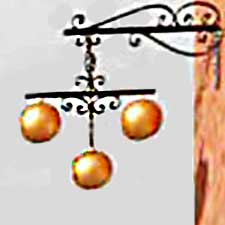
A pawnbroker was someone who lent money on the security of an object pawned. He earned his money by selling off the object if the person who pawned it couldn't repay the loan inside a year and a day. This page describes how pawnbrokers' shops could be recognised from their sign of three balls, how they traded, common items traded, how they were used, the disgrace of needing to use them and the desolation of losing pawned items in a fire. All brought to life with firsthand recollections.
____
Extracted from the memoirs of the webmaster's mother(1906-2002) and edited by the webmaster with further research and firsthand contributions from others
How pawnbrokers traded
Anyone in need of ready cash would take one or more things that they owned to a pawnbroker. There was always a local one. He would loan them a certain amount of money using the loaned items as security. The amount of the loan was based on what the pawnbroker thought he could sell the things for, plus quite a heavy commission for himself.
The goods could be redeemed at any time up to a year and a day if the loan was repaid. If it couldn't be repaid, the goods reverted to the pawnbroker who sold them at a commission. Pawnbrokers did a good trade and made a good income for themselves because people were much poorer in my childhood in the early 1900s. They needed the services of a pawnbroker as they lived in fear of not having enough ready cash for food, so having to put themselves and their families into the workhouse.
Pawnbrokers shop sign
Pawn shops could be recognized from some distance away because there were always three balls hanging outside, usually of a gold colour.
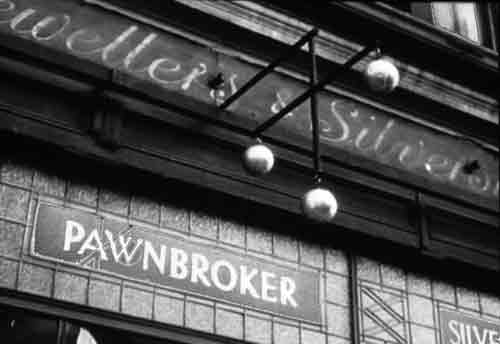
Front of an old pawnbroker's shop showing the traditional three balls. Note its name in beaten glass tiles.
The origin of the sign is lost in history, although a web search will come up with several different possibilities. The one I like best, which may or may not be true, is that Saint Nicholas gave three bags of gold to a poor man who had no dowry for his daughters.
The disgrace of needing to use a pawnbroker
Although women where I lived in Edmonton were clearly visible to everyone as they queued outside the pawn shop, in others areas, families tried to keep their needs for a pawnbroker quiet.
To my knowledge, there was a stigma about having to use a pawnbroker. So children, rather than their parents, were sent with the things to pawn, and the pawnbroker received them round the back of the shop. If they were met by anyone they knew on the way, they were told to say that they were taking the things to their aunt.
Volunteer at the Black Country Museum
Typical items pawned
Pawnbrokers would accept anything that they could sell later. Particularly common were all types of clothes and jewellery, including watches. Watches were very expensive in those days and their cost should not be confused with today's digital ones.
I recall seeing women standing outside the pawnbrokers with bundles of clothes and bedding waiting for the shop to open on a Monday morning. Then the women would redeem these bundles at the end of the week when or if their husbands brought home enough wages. It was a vicious circle in that, once started, it had to continue. I dread to think how the families lived without a full complement of bedding and clothes during the week.
Children's boots were a common pawnbrokers' item. I say boots not shoes because leather boots were what children always wore. I don't know whether mine as a child came from a pawnbroker or were just someone's cast offs, but I do know that they were never professionally fitted to my feet. I have had misshapen feet and bunions all my life as a result.
The jewellery was mostly second-hand and had been pawned more than once. Now that I am an adult, I have thought about it a lot and have wondered what stories of sadness there were behind the jewellery that couldn't be redeemed.
Personal experience of pawning a man's pocket watch
My father-in-law used to tell us that during the depression his family was so hard up that if he wanted to go to Bethnal Green to see relatives, he had to pawn his watch for the fare. It used to take months to get the watch back, but he did it a few times.
Name withheld
A pawn shop window - full of heartbreak
There was a pawnshop near where I used to live and the window was always full of 'treasures' for sale, indicating how many poor people could never redeem their pledges - a window full of heartbreak.
Kevin Bell
Pawnbrokers' receipt book
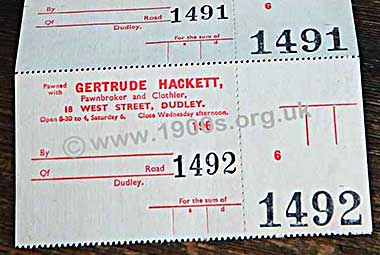
Pawnbroker's receipt book, photographed in the Black Country Museum.
Note the numbered tear-off strip for the customer to keep in order to retrieve
the item, with columns for the amount borrowed in
shillings and
pence. The pound
column was there but not labelled as presumably seldom used because a
pound was a great deal of money in those days. Presumably the date of pawning
was handwritten.
Local pawn shops as a landmarks
The following contribution shows just how common it was for women to need pawnbrokers.
Mum told me that on Monday mornings, the bus conductors, instead of calling out 'Bull Lane' (the nearest bus stop to the shop) used to call out "Arry's pawn shop!"
Pat Slocombe
Fire in a pawnbrokers shop - but no insurance
People who needed to pawn their belongings to feed their families were of course extremely poor, but imagine how much worse for them if there was a fire in a pawn shop. There was no insurance and therefore no way to recover what had been pawned, even if it had been possible to save the money to do so. There was a song from the old Tyneside music halls which describes such a situation. Although sung as an comic song, it held a dark shadow of truth. A pawnshop burning down would have been a deeply felt tragedy in the locality.
To a non-Geordie, the words of the song would seem like a foreign language, so rather than quote it all, here is my 'translation'. Unfortunately it doesn't scan or rhyme like the original, and the line lengths are only clear on a wide screen, rather than on a phone. Nevertheless it adds so much feeling to what poor people's lives were like that it is worth reading.
Kevin Bell
The Pawnshop Blazing
My wife, Sal, was combing out her hair (preparatory to going to bed),
While I was becoming dozy, while snoozing in our easy chair which makes a man very cosy.
Then from the street came shouts and cries.
Sal said, 'listen!' and I rubbed my eyes.
Then (God's) mercy, screams of 'fire!',
I heard, I jumped down the stairs in one bound, and
goodness! I saw a disturbing sight, thousands of people crowding the street.
It was the pawnshop blazing!
The womenfolk, it was sore to see, lamenting their misfortune,
For many a gown and white chemise was burnt with little children's dresses.
Peg Putty stamped and cried, 'O! Dear, my husband, Geordie's, trousers are gone I fear,
My pretty shawl, my daughter Bella's frock,' says Betty Mills, 'and there's our clock and all of my young son's clothes, my pillowslips and corsets.
They're in the pawnshop blazing!
'O! Mercy, I'll be beaten too,' cried Orange Jenny, bawling,
'I pawned my husband, Ned's, clothes to go out drinking, but soon I shall have to pay for it. He thinks, poor soul, his clothes are safe, he'll want his suit on Friday night
And worse and worse, he'll quickly know that my earrings, wedding ring and everything valuable,
is in the pawnshop blazing!”
A particularly tall seaman known as Long Skipper Jack came hurrying up the Side (the main street from Newcastle quayside to the [then] new part of Newcastle) cursing and swearing.
Said he, 'what is the matter here? Well, this is a fine state of affairs! O! Friends, surely this can't be true, this can't be Trotter's pawnshop that I see!'
Then he took out his tobacco pouch and pulled a pawnshop receipt ticket from his
wallet, well sink the souls of all of them, there's all my fortune gone to
nothing.
It's in the pawnshop blazing!'
The yells and cries and loud curses and shouts of unbelieving amazement,
And little children in the crowd increased the chaos.
There's many a wife will rue the day she pawned her husband's clothes.
And men will groan in bitter grief, for there is no recourse to get the value of
their goods back from the pawnshop, they will find all of their work will have
been in vain, they will never see their clothes again.
They are in the pawnshop blazing!
This world was better by far, I'm sure, when pawnshops didn't exist,
And poor folk could secure their daily bread without having to pawn their belongings (the receipt ticket being known as a Deed of Shame).
The pawnshop storage duckets are as big as horse stalls, there's hellfire in the three brass balls (symbol of a pawnshop).
The pawnbroker's profits are great, our chance of redeeming our belongings is small, they often keep the goods we pawn, just like the plagues of Egypt, sent by God, the worry of being able to redeem the goods banishes domestic peace and contentment,
And I wish they ALL were blazing
Pawnbrokers in Edmonton
Our pawn shop in Edmonton was run by two brothers by the name of Evans. One window was given over to jewellery and the other to everything else.
My Grandfather was Henry (Harry) Messer who owned the pawnbroker's and general outfitter's shops at 119-121 Silver Street, Edmonton. The business was originally owned by Mr Evans, to whom my Grandfather was apprenticed. When Mr Evans wanted to retire, none of his children were interested in taking over the business and my Grandfather bought it. However, the locals often still referred to the shop as 'Evans'.
Pat Slocombe
Edmonton census data from the webmaster
I was unable to find pawnbrokers named Evans in Edmonton in the 1911 census. There were three Messer brothers at 119 Silver Street, all brothers-in-law to the main occupant David Punnett. The brothers were Henry Messer, 29, a pawnbroker manager David Messer, 20, a clerk, and Horace Messer, 17, a shop assistant in a pawnbroker shop. These Messer brothers did set up a pawnbroker business in Silver Street, as Doreen Buckland remembers in the 1930s. It was run by brothers Harold and Horace Messer who lived at 4 Bulwer Road. Yet she reports that older people still referred to the shop as Evans.
If you can add anything to this page or provide a photo, I would be pleased if you would contact me.
Text and images are copyright
sources: early 20th century material
sources: ww2 home front and other material
contact
the webmaster/author/researcher/editor
privacy policy

