





 shopping
process early
20th century weights
and
measures old bakers
shops old butchers
shops old
fishmongers old grocers
shops old
Co-op shops old
dairies old
greengrocer
shops old sweet
shops

Butchers and butchers' shops, early 20th century
____
Extracted from the memoirs of the webmaster's mother(1906-2002) and edited by the webmaster with further research and firsthand contributions from others
Before supermarkets, all shops were small and sold only one type of merchandise. This page is about butchers. If you wanted to buy meat and lived away from a farm, you went to a butchers shop also just called a butcher, although the word butcher was also used for salesmen in a butchers shop.
The butcher
Physique
Butchers were skilled at where and for how long to hang meat for it to become tender without going bad, and at how and where to cut it for cuts to sell to customers. Hawling and hacking into meat was heavy work, and butchers needed to be strong. Our local butcher was typical because he was big with a florid face.
Clothes
Butchers could be recognised by their clothes, not unlike a uniform. The colours varied from shop to shop, but otherwise: a white shirt, a striped or plain white apron, plain dark trousers and a straw boater hat. Round the waist was a rather sagging belt. I don't know its purpose.
Red was a common colour for the strips, presumably to minimise the blood stains from the animals, but some shops prefered all white, probably to show that their clothes were clean.
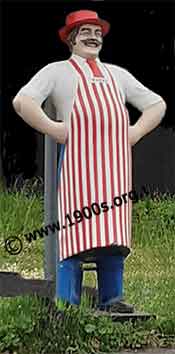
A model outside a butchers shop today, suggesting that its meat is traditional quality. It is very much like a traditional butcher except that the belt is missing.
Outside a butchers shop
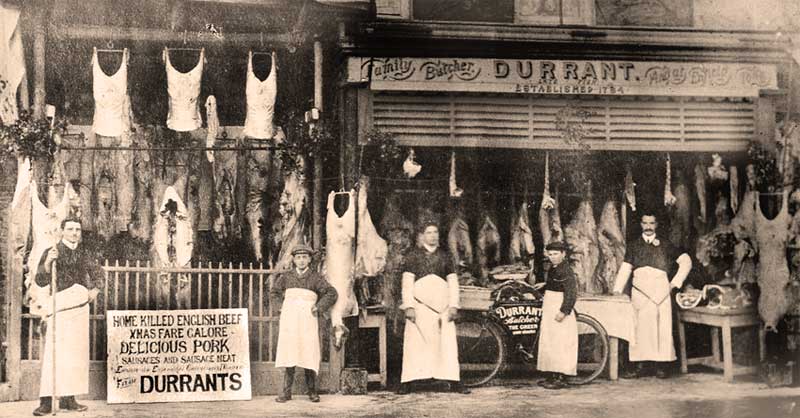
I am grateful to Mirander Pender - see https://edmontonodyssey.blogspot.com - for this photo of Durrants butchers shop in Lower Edmonton, dated 1910. It is special because it really does show everything involved in butchery during the Edwardian era. Note the way that the sides of meat were hung outside as well as inside the shop; the large cuts of beef or pork on the butcher's block, the clothes that the butcher and his assistants were wearing with their large white aprons and belts round their waists; the tools that they were holding and the very young delivery boy with his delivery bike. The only obvious difference between the photo and my mother's description of a butcher's shop is that the chopping boards in the photo have four legs rather than three - so probably both were used.
The placard on the left reads:
HOME KILLED ENGLISH BEEF
XMAS FARE GALORE
DELICIOUS PORK
SAUSAGES AND SAUSAGE MEAT
<...illegible...>
DURRANTS
The sign above the shop reads:
Family Butcher DURRANT Also at Enfield Town
ESTABLISHED 1784
Inside a butchers shop
Inside butchers shops, sides of beef would either be hanging up from large hooks suspended in the shop or in an ice-safe which was kept cool with ice supplied by the ice man.
Butchers kept their shops beautifully clean with fresh sawdust on the floor and shining tiles on the walls.
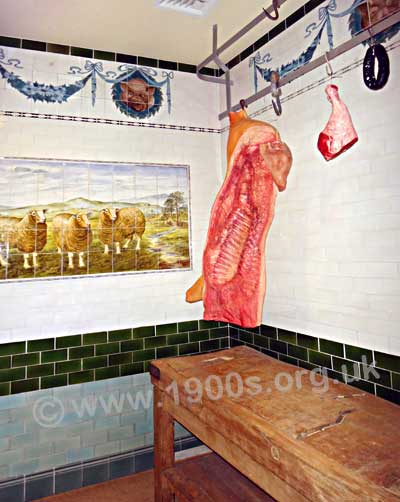
Reproduction of inside a butcher's shop, photographed in Jackfield Tile Museum. Note the side of meat hanging from a hook. (There would have been several of these - and it was common to see them in butchers shops right into the 1950s.) Also note the wooden chopping board which always had a dip in it, made through constant hitting - and also note the tiled walls which always included a picture.
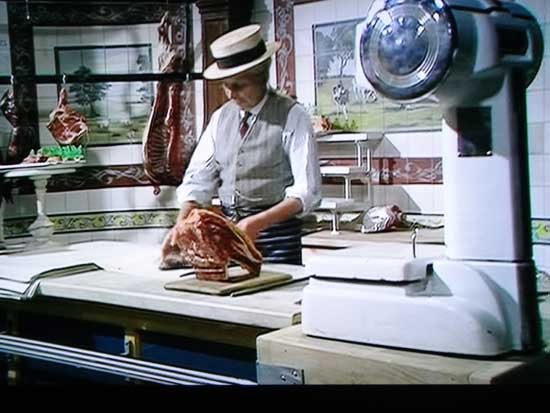
Inside a butcher's shop. Note the side of meat hanging from a hook, screen shot from Dad's Army. Note the tiled walls which include pictures of country scenes with cows.
At the end of every day, the chopping boards, which looked rather like heavy three-legged stools were scrubbed with wire brushes and then washed. Choppers and knives had the same treatment. The day's sawdust on the floors, which had absorbed or coated spills, was swept up and new was put down.
Guest contributions
Use of sawdust in old butchers shops
My grandfather's butcher's shop had been in the family for nearly 200 years before it closed. The bookshop which bought it entirely refurbished it and found nearly half a metre of sawdust under the floor. This had slipped through the gaps in the floorboards over the years.
Neil Cryer
Cleaning butchers' chopping boards
In my experience, steel scrapers were used to clean the chopping blocks as wire brushes would have been too difficult to steralise.
Desmond Dyer
Suet
Suet is the raw, hard fat of beef, lamb or mutton around the loins and kidneys. It was bought as a lump and the butcher sometimes cut it out of a side of beef while I watched. It was minced at home.
Sausages
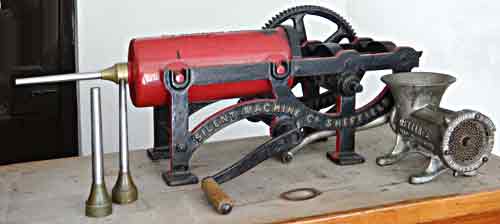
Sausage machine, photographed at Blists Victorian Town. Note the hand operated mincer on the right which prepared the sausage meat and the various nozzles on the left for different thicknesses of sausages. The handle is at the back.
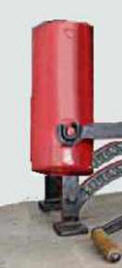
Cylinder tilted into a vertical position.
The cylinder would be filled in the vertical position (as shown in the right-hand mock-up) before the fitting of the piston, lowering, connecting up and screwing on the required nozzle. Mock-up and additional information courtesy of Desmond Dyer.
Sausages were made in full view in a red sausage machine. In at the top would go the minced meat (and probably some meal and flavourings as well, although I can't be sure). Then butchers would put the skins on the nozzle and turn the handle.
It was fascinating for me to see the butchers take the long strings of the emerging sausage in their hands and with a flip of the fingers make a string of individual sausages. Unless the weather was exceptionally hot, these would be put over hooks and hung in shop windows.
Bones and fat
It was not unusual for bones to be on sale for women to use to flavour their soups.
Lumps of fat were on sale too for rendering down for dripping, which was a popular meal on its own, spread on a slice of toast. It was always beef dripping.
Mince
Minced meat was generally suspect because customers couldn't be sure what might have gone into it. Many women bought meat for mincing and minced it at home with a mechanical mincer. The better butchers, though, wouldn't sell ready-minced meat. They had a mincer on the side, would allow customers to choose the fresh meat that they wanted minced and then mince it in front of them. Many a time I heard my mother say to my father as she put a dish of mince in front of him, "It's all right: I saw it being minced."
Joints of meat
I was never directly involved in buying joints of meat. That was for my mother - and it was always beef. She didn't stay with one butcher. She loved looking at meat in butchers shops. She would say, "That's a lovely bit of beef", etc. I wouldn't have known.
Childhood errands to the butcher
I had to go to the local butcher about once a week and it was usually to get ¾ of a pound of leg of beef and a ¼ of a pound of beef suet for a meat pudding. I was never happy about this errand because my mother would always tell me to tell the butcher that she didn't want too much sinew. Yet far too often there was too much for her taste. Then she made me take the meat back which made me feel uncomfortable.
The butcher I was sent to was on the corner of Silver Street and Bulwer Road in Edmonton.
If you can add anything to this page or provide a photo, I would be pleased if you would contact me.
Text and images are copyright
sources: early 20th century material
sources: ww2 home front and other material
contact
the webmaster/author/researcher/editor
privacy policy

